
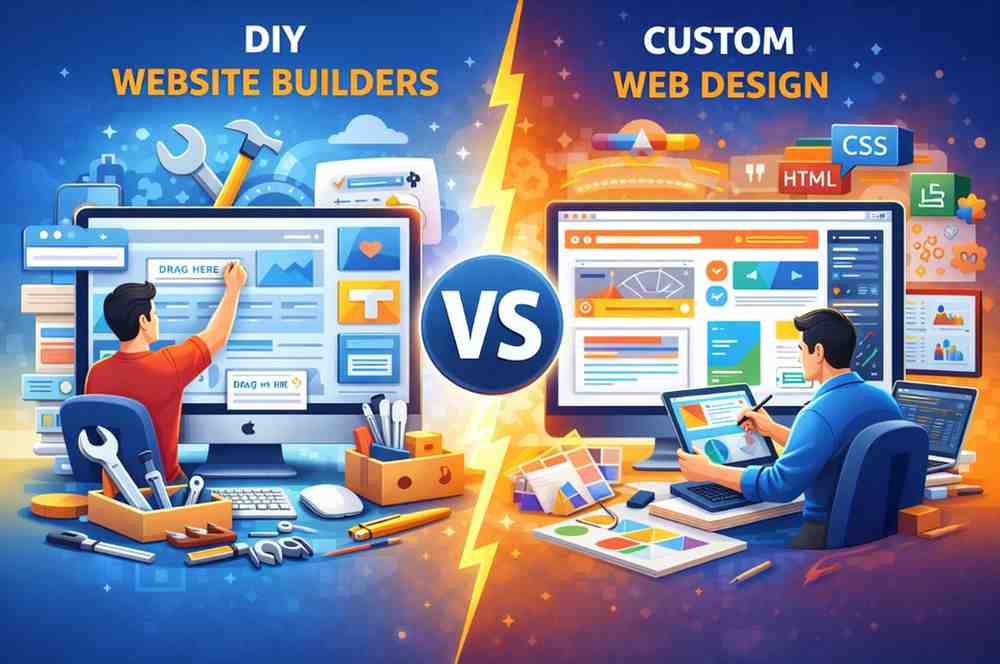
DIY Website Builders vs Custom Web Design: Is Your Startup Settling for Less?
Launching a startup involves making countless decisions every day, usually under significant financial pressure. One of the first and most visible choices you will face is how to establish your online presence. For many founders, the path seems obvious: sign up for a popular platform, pick a template, and launch. It feels efficient, cost-effective, and fast.
However, relying solely on template-based platforms often leads to a harsh reality check down the road. Statistics suggest that 76% of small businesses report their website does not meet their expectations. This dissatisfaction often stems from the fundamental limitations inherent in drag-and-drop tools. If you are currently debating DIY website builders vs custom web design, it is vital to look beyond the initial price tag and consider the long-term trajectory of your business.
Your website is more than a digital brochure; it is often the first interaction a potential client has with your brand. The question is whether a generic framework can truly support the unique weight of your business goals.
The Illusion of Convenience in DIY Platforms
There is no denying the initial appeal of do-it-yourself platforms. They market themselves on ease of use, promising that anyone can build a stunning site in a few hours without writing a single line of code. For a hobbyist or a temporary landing page, this is often sufficient. However, for a tech startup or a business aiming for significant market share, the cracks begin to show quickly.
The primary issue lies in the rigid architecture of these platforms. When you choose a builder, you are renting space within a closed ecosystem. You do not own the code, and you are bound by the limitations of their themes. While you might save money in the first month, the opportunity cost of a site that cannot convert visitors or rank well on search engines is far higher.
When analyzing DIY website builders vs custom web design, you must evaluate what you are sacrificing for that convenience. Often, the trade-off is distinctiveness and functionality.
The Customization Trap: Why Templates Fall Short
Branding is about differentiation. In a crowded market, your startup needs to stand out immediately. The problem with DIY builders is that thousands of other businesses are using the exact same templates. You might change the colors and swap out the logo, but the structural “DNA” of the site remains generic.
Limited customization is a significant red flag for growing companies. You might want a specific customer portal, a unique animation that explains your tech stack, or a non-standard navigation flow that suits your specific user journey. On a DIY platform, implementing these features often requires awkward workarounds or third-party plugins that slow down your site.
In contrast, bespoke development starts with a blank canvas. Every pixel is placed with intention. The user interface is designed specifically for your target audience, not a general average of all internet users. This level of intentionality signals professionalism and competence to your investors and customers.
Scalability: Will Your Site Grow With You?
Startups are designed to grow. You might start with ten users, but your goal is ten thousand. This is where the debate of DIY website builders vs custom web design becomes a conversation about technical debt.
DIY sites are rarely built for high scalability. As you add more pages, products, or multimedia content, these platforms often suffer from performance degradation. They are not optimized for complex databases or high-traffic volumes. If your business pivots—a common occurrence in the startup world—and requires new functionality, you may find yourself hitting a hard wall.
We frequently see businesses reach a breaking point where they must scrap their DIY site entirely and start over because the platform cannot support their next phase of growth. Custom web design builds a foundation meant for expansion. Using clean, modular code allows developers to add new features seamlessly without breaking the existing infrastructure.
Performance and SEO: The Hidden Battleground
Search engines care deeply about how your website is built. To rank high in search results, your site needs to be fast, secure, and structured in a way that bots can easily crawl. This is an area where custom solutions usually outperform drag-and-drop competitors.
DIY builders often generate “code bloat.” To make their drag-and-drop features work for everyone, they load massive amounts of unnecessary scripts in the background. This slows down page load times, which is a critical ranking factor for Google and a major annoyance for mobile users.
When comparing DIY website builders vs custom web design regarding SEO (Search Engine Optimization), custom development offers granular control. We can optimize every image, minify code, and structure schema markup specifically to help search engines understand your content. This Answer Engine Optimization (AEO) ensures that when users ask voice assistants or search engines questions related to your industry, your site is technically primed to provide the answer.
Security Considerations
Security is another factor often overlooked. While platforms handle basic security, they are also massive targets for hackers due to their popularity. A vulnerability in a popular plugin can affect millions of sites instantly. Custom web applications can be hardened specifically for your threat landscape, offering a higher tier of data protection for your users.
The Economic Reality: Cost vs. Investment
It is natural to worry about the budget. Custom development requires a higher upfront financial commitment than a monthly subscription to a builder. However, viewing this expense as a cost rather than an investment is a strategic error.
Consider the total cost of ownership. A DIY site might cost less to launch, but if it converts at a lower rate, crashes during traffic spikes, or requires a complete rebuild after eighteen months, it becomes significantly more expensive.
At WEAMSE, we have assisted numerous tech startups in transitioning from these restrictive platforms to bespoke web experiences. The ROI comes from a site that works harder for you—automating processes, capturing better leads, and reducing the administrative burden on your team.
Making the Transition to Bespoke Web Experiences
If you have already launched on a builder and feel the friction, you are not alone. It is a common lifecycle stage for startups. The transition to a custom solution is a sign that your business is maturing.
The process involves more than just copying your old content to a new system. It is an opportunity to re-evaluate your brand strategy. A professional development team does not just code; they consult. We look at your user analytics, identify drop-off points, and engineer a solution that solves those specific business problems.
When you move away from the limitations of templates, you gain the freedom to innovate. You can integrate complex APIs, build custom dashboards, and create immersive experiences that truly resonate with your audience.
Final Thoughts
Your online presence is the anchor of your digital identity. While templates offer a quick start, they rarely sustain a growing company for long. The comparison of DIY website builders vs custom web design ultimately comes down to your ambition. If you are building a business meant to last and lead, your digital infrastructure should reflect that resilience.
Don’t let a platform limit your potential. A website should not just look good; it must be a high-performance asset that drives your startup forward.
Frequently Asked Questions (FAQ)
What is the main difference between DIY website builders vs custom web design?
The primary difference lies in ownership and flexibility. DIY website builders use pre-made templates and hosted platforms where you have limited control over the underlying code and functionality. Custom web design involves building a site from scratch using code tailored to your specific business needs, offering complete freedom in design, scalability, and ownership of your digital asset.
Why is custom web design better for SEO than DIY builders?
Custom web design allows for cleaner, leaner code compared to the “code bloat” often found in DIY platforms. Developers can optimize site speed, mobile responsiveness, and schema markup with precision. This technical superiority helps search engines crawl and index the site more effectively, often resulting in better rankings and improved Answer Engine Optimization (AEO) performance.
Is it worth switching from a DIY builder to a custom site for a small startup?
Yes, especially if you plan to scale. While DIY builders are fine for validation, 76% of businesses eventually find them limiting. Switching to a custom site eliminates technical debt, improves user experience, and ensures your infrastructure can handle increased traffic and complex features as your startup grows.
How does custom web design impact brand identity?
Custom design ensures your brand stands out rather than blending in. DIY platforms rely on templates used by thousands of other sites, which can dilute your brand’s uniqueness. A bespoke site is designed specifically around your brand guidelines, voice, and customer journey, creating a cohesive and memorable experience that builds trust with your audience.