
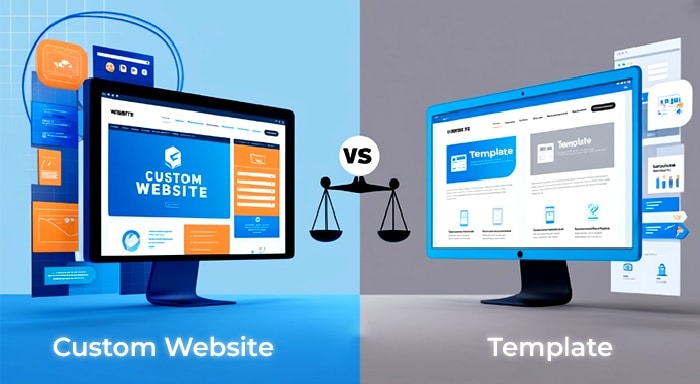
Meta Description: Choosing between a custom vs template website can be challenging. Discover the pros, cons, and conversion impacts of each approach to make the right choice for your business.
Custom vs Template Website: What Is Right for Your Business?
As a marketing manager, you need a web solution that not only looks great but actively drives measurable results. Research shows that 94% of first impressions are strictly design-related. When a potential customer clicks your link, you have mere seconds to communicate trust, authority, and value. This high-stakes environment means deciding between a custom vs template website is one of the most critical choices you will make for your brand. While the question comes up frequently in web design discussions, it can still feel daunting to answer definitively.
Understanding the Baseline: What Are Your Options?
Before diving into the complexities of engagement metrics and conversion optimization, it helps to establish clear definitions for both approaches.
The Pre-Designed Template Approach
A template is a pre-built layout offered by various platform builders. Developers or marketers purchase these themes and plug in their specific text and images. At first glance, templates seem incredibly cost-effective and fast to deploy. However, they consistently lack true uniqueness. Because these themes are sold to thousands of buyers, potential customers might see the exact same design structure across multiple competing businesses. This repetition severely dilutes your brand identity, making your company highly forgettable to a prospective buyer browsing multiple vendors.
The Bespoke Web Design Approach
On the other hand, custom web design involves building your platform from the ground up. This process requires a dedicated team of designers, developers, and strategists. Custom websites naturally come with a higher price tag and longer development timelines. However, they offer unparalleled adaptability. Every single element, from the user interface to the backend architecture, is built in total alignment with your brand vision, operational values, and specific customer requirements.
Core Factors in the Development Strategy Debate
Choosing the right technical foundation requires looking beyond initial launch costs. You must consider the long-term operational impact on your marketing campaigns.
Brand Identity and Authentic Representation
Your business is unique, and your online presence should reflect that authenticity. Off-the-shelf themes often force you to cram your unique value propositions into rigid boxes not designed for your specific narrative. Bespoke development removes these constraints, allowing you to design an interface that speaks directly to your target audience without compromise.
User Experience and Customer Journeys
Pre-packaged themes are built to serve a broad range of industries, meaning they are packed with features and code bloat that you likely do not need. This can slow down page load speeds and frustrate users. Bespoke development ensures that the user journey is tailored specifically to your conversion funnel, keeping visitors engaged and guiding them logically toward desired actions.
Scalability and Future-Proofing
As your company grows, your marketing needs will evolve. You may need to integrate complex third-party CRM systems or unique customer portals. Rigid themes frequently break when modified heavily. A bespoke platform is built with scalability in mind, accommodating new features seamlessly as operational demands increase.
Why Your Development Choice Impacts ROI
At WEAMSE, we have collaborated with various startups and marketing heads across the globe. Through these partnerships, we have gathered extensive data on user behavior and site performance. Our experience clearly shows that investing in a bespoke solution directly influences bottom-line metrics.
When evaluating a custom vs template website, marketing managers must look at conversion potential. We have seen custom platforms achieve engagement and conversion rates up to three times greater than standard theme-based sites. This massive increase in return on investment stems from faster load times, optimized user funnels tailored to specific buyer personas, and a distinct aesthetic that immediately establishes brand trust.
Weighing the Advantages and Disadvantages
To simplify this complex choice, let us examine the specific benefits and drawbacks associated with each method.
Advantages and Drawbacks of Pre-Built Themes
- Advantage: Lower upfront financial investment for the initial launch.
- Advantage: Faster turnaround times if content is already prepared.
- Advantage: No advanced technical knowledge needed for basic text and image setup.
- Drawback: High risk of blending in with competitors due to duplicate designs.
- Drawback: Limited customization features and difficult third-party integrations.
- Drawback: Hidden long-term costs due to paid plugins and ongoing maintenance conflicts.
Advantages and Drawbacks of Bespoke Platforms
- Advantage: Complete creative control over brand identity and the end-to-end user experience.
- Advantage: Clean, optimized code that drastically improves search engine rankings and load speeds.
- Advantage: High scalability to support future business expansion without needing a total rebuild.
- Drawback: Requires a larger initial financial budget.
- Drawback: Takes weeks or months to launch properly from start to finish.
- Drawback: Requires hands-on collaboration with an experienced agency or development team.
How to Finalize Your custom vs template website Decision
The right choice ultimately depends on your immediate priorities and long-term business goals. If you are running a temporary campaign, testing a minimal viable product with zero budget, or just need a simple digital placeholder, a standard theme might suffice temporarily. However, if you are an established brand, an ambitious startup, or a marketing manager tasked with aggressively scaling lead generation, bespoke development is the clear path forward.
Navigating the custom vs template website dilemma requires balancing cost, quality, and performance. We believe in ensuring every platform we create represents its brand authentically, turning passive visitors into active revenue generators.
Frequently Asked Questions
How do I know if I need a custom vs template website?
You need a custom vs template website if your primary goals include building a unique brand identity, scaling functionality, maximizing search engine visibility, or integrating specialized software. Conversely, choose a template if your budget is strictly limited and you only need a basic informational page launched immediately.
Is bespoke development better for search engine optimization?
Yes, bespoke development is significantly better for SEO. When comparing the SEO capabilities of a custom vs template website, custom platforms win because developers can write lightweight code, optimize site architecture specifically for web crawlers, and eliminate the heavy code bloat found in off-the-shelf themes.
What are the differences in launch timelines?
The development timeline for a custom vs template website differs significantly. Pre-built themes can be launched in just a few days if all content is ready. Bespoke development takes anywhere from four weeks to several months, depending on design complexity, user testing, and required backend integrations.
Can I transition from a basic theme to a bespoke platform later?
Absolutely. Many businesses start with a pre-designed layout during their initial launch phase to save money. As they generate revenue and identify the limitations of their current setup, they partner with development agencies to build a fully tailored platform that meets newly expanded requirements.
Explore the Possibilities for Your Brand
Curious what your current digital presence actually says about your business? The stakes are too high to settle for a forgettable online experience. Ultimately, the custom vs template website choice comes down to how much you value first impressions, user engagement, and sustainable growth. At WEAMSE, we are ready to help you navigate this balance between cost and quality. Let us explore the possibilities together and build a web application that drives real results for your business.