
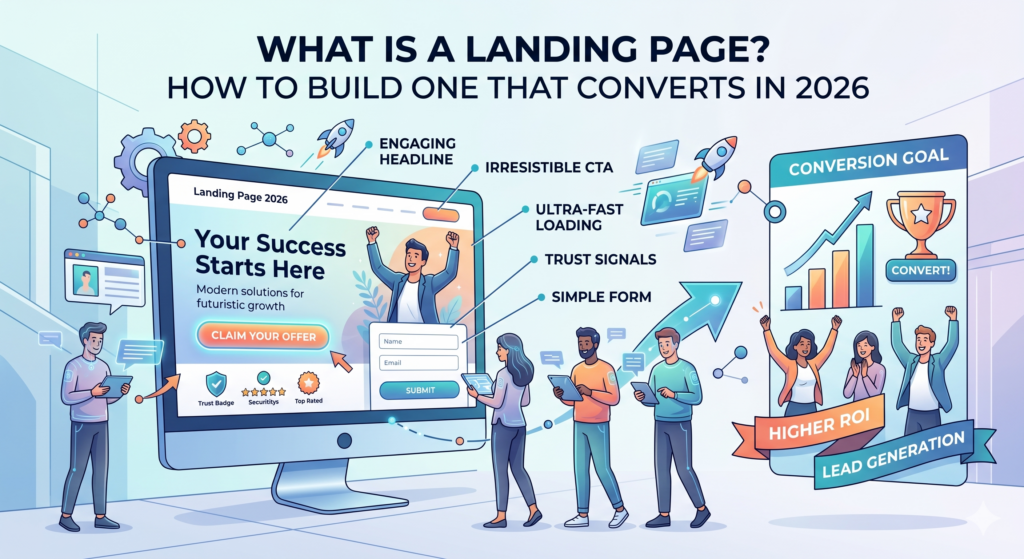
What Is a Landing Page? How to Build One That Converts in 2026
A landing page is a standalone web page designed with a single, focused objective: to convert a visitor into a lead or customer. Unlike a homepage, which serves multiple audiences and goals, a landing page eliminates distraction and drives one specific action, whether that is filling out a form, booking a call, downloading a resource, or completing a purchase. In digital marketing, landing pages are the most powerful conversion tool available to any business.
If your website is generating traffic but struggling to produce consistent leads, the missing piece is almost always a strategically designed landing page.
The Real Difference Between a Landing Page and a Homepage
This is one of the most common points of confusion for business owners, and it costs them dearly in lost conversions. A homepage is the front door to your entire business. It introduces your brand, provides navigation to multiple sections, and serves visitors at every stage of awareness. It is designed for exploration. A landing page is the opposite. It is designed for commitment. There is no global navigation to distract the visitor. There are no links pulling them toward other areas of the site. Every element on a well-built landing page has one job: to support a single conversion goal.
Think of it this way. Your homepage is a showroom where visitors browse freely. Your landing page is a private consultation room where a specific offer is presented to a specific visitor who arrived with a specific intent. The psychology is entirely different, and the results reflect that difference dramatically. Conversion rates on dedicated landing pages regularly outperform standard website pages by two to five times.
| Feature | Homepage | Landing Page |
| Primary Goal | Brand awareness and exploration | Single conversion action |
| Navigation | Full menu with multiple links | Minimal or no navigation |
| Audience | Broad, all-stage visitors | Specific, targeted segment |
| Content Focus | Multiple products, services, values | One offer or one campaign |
| Typical Conversion Rate | 1–3% | 5–15%+ (optimized) |
| Traffic Source | Organic, direct, referral | Paid ads, email, specific campaigns |
Why Landing Pages Are Non-Negotiable for Business Growth in 2026
The digital advertising landscape has become extraordinarily competitive. The cost per click on Google Ads and Meta has climbed year over year, meaning every visitor you pay for is more expensive than ever before. Sending that paid traffic to a generic homepage is one of the most expensive mistakes a business can make. A visitor who clicks an ad for a specific service and lands on your homepage, rather than a page dedicated to that exact service, immediately encounters friction. They have to search for what they were promised. Most will not. They will leave.
A dedicated landing page solves this problem entirely. It delivers message match, meaning what the visitor was promised in the ad is exactly what they see when they arrive. This consistency builds immediate trust and removes the cognitive load of searching. The result is a dramatic reduction in bounce rate and a proportional increase in conversion rate. Beyond paid advertising, landing pages are critical for email marketing campaigns, social media promotions, webinar registrations, free trial offers, and any scenario where you want to guide a specific segment of your audience toward a specific outcome.
At WEAMSE, we have seen clients double their lead volume within weeks simply by redirecting existing campaign traffic from homepages to purpose-built landing pages. The traffic did not change. The page did.
The Anatomy of a High-Converting Landing Page
Understanding what a landing page is technically is only the beginning. Understanding what makes one convert is where the real competitive advantage lives. Every high-performing landing page shares a common set of structural elements, each serving a precise psychological and functional purpose.
The Hero Section
The hero section is what the visitor sees the moment the page loads, before any scrolling. It must immediately communicate what the offer is, who it is for, and why it matters. This is accomplished through a compelling headline, a supporting subhead line, and a clear call-to-action button. You have approximately three seconds to establish relevance before the average visitor decides whether to stay or leave. Your headline cannot be clever or vague. It must be clear. “Get 50 More Leads Per Month With a Custom Landing Page” will always outperform “Unlock Your Digital Potential.”
Social Proof
Nothing reduces purchase anxiety like evidence that other people have already made the same decision and benefited from it. Social proof on a landing page comes in several forms: customer testimonials with real names and photos, star ratings and review counts, client logos, case study statistics, and media mentions. The position of social proof matters. Place it immediately below the hero section and again adjacent to your primary call-to-action form. The goal is to surround the conversion moment with reassurance.
The Benefit-Driven Value Proposition
Most business owners instinctively write about features. “Our platform has 20 integrations.” “Our service includes monthly reports.” These are features. Visitors do not buy features. They buy outcomes. A high-converting landing page translates every feature into a tangible business benefit. “Our platform connects with the tools you already use so your team can launch campaigns in minutes, not days.” The distinction is the difference between talking about your product and talking about the visitor’s future. Always write from the perspective of the person reading, not the company delivering.
A Frictionless Lead Capture Form
The form is the mechanical center of your landing page. Its design directly determines your conversion rate. The most common mistake is asking for too much information too early in the relationship. For most top-of-funnel landing pages, a form requesting a name, business email address, and perhaps one qualifying field is optimal. Every additional field you add reduces completion rates measurably. The form should be visually prominent, positioned above the fold wherever possible, and accompanied by a privacy reassurance such as “We never share your information.” The submit button copy also matters enormously. “Submit” is passive and weak. “Get My Free Strategy Session” or “Start Increasing Conversions Today” creates momentum and reinforces the value of the action.
A Single, Clear Call-to-Action
One of the most consequential rules in landing page design is the rule of one: one offer, one audience, one call-to-action. When a page presents multiple competing actions, visitors experience decision paralysis and frequently choose the default option, which is to do nothing. Every micro-decision you force a visitor to make is an opportunity for them to exit. Remove those decisions by making the path forward singular and obvious. Your CTA button should appear multiple times on longer pages, but it should always direct to the same destination.
Technical Factors That Determine Landing Page Success
Design and copy are only two dimensions of landing page performance. The technical foundation underneath them determines whether those elements ever get a chance to work. Page speed is the most critical technical variable. Google’s research has consistently shown that conversion rates drop sharply as page load time increases. A page that takes four seconds to load will convert at a fraction of the rate of one that loads in under two seconds. This is not a minor consideration for optimization; it is a foundational requirement. Compressing images, eliminating render-blocking scripts, leveraging browser caching, and using a reliable hosting infrastructure are non-negotiable steps before any campaign goes live.
Mobile responsiveness is equally non-negotiable. In most industries, the majority of landing page traffic now arrives on mobile devices, and for paid social campaigns, that figure often exceeds seventy percent. A landing page that is not optimized for mobile viewports will leak conversions at every touchpoint. Buttons that are too small to tap accurately, forms that require excessive zooming, and hero sections that render poorly on smaller screens all contribute to a degraded experience that costs you leads directly. Our guide on website speed optimization covers the technical depth required to build a fast, reliable digital foundation that supports high-performing campaigns.
Schema markup and structured data also play an increasingly important role in landing page performance, particularly for Answer Engine Optimization. As AI-powered search engines and assistants become a primary discovery channel, pages that use proper schema to communicate their purpose, offer, and authority are surfaced more prominently in AI-generated responses. This is no longer optional for businesses competing for visibility in 2026.
The Landing Page Optimization Loop: How to Improve Conversion Rates Over Time
Building a landing page is not a one-time event. The highest-performing landing pages in any industry are the result of continuous testing, analysis, and iteration. The process begins with a performance baseline: tracking conversion rate, bounce rate, average session duration, and scroll depth from the moment the page goes live. These metrics tell you what is happening. They do not, by themselves, tell you why. That requires qualitative insight gathered through heat mapping tools like Hotjar or Microsoft Clarity, which show you where visitors click, where they stop scrolling, and what elements they interact with most.
Armed with both quantitative and qualitative data, you can form educated hypotheses for improvement. Perhaps the heat map reveals that most visitors never scroll past the hero section, suggesting the headline is not compelling enough to create forward momentum. Perhaps the form completion data shows that visitors are abandoning the form at the second field, suggesting that field needs to be removed or moved to a secondary step. These hypotheses are then tested through A/B experiments, where a portion of traffic is directed to a variant page with the proposed change. Over multiple testing cycles, your conversion rate compounds upward.
This optimization loop is one of the primary reasons that professionally managed landing pages consistently outperform self-built ones. The expertise required to interpret data correctly, form accurate hypotheses, and implement technically sound experiments is a specialized skill set. Businesses that treat this as an ongoing investment rather than a setup cost see sustained, compounding returns on their marketing spend.
Landing Pages vs. Website Pages: When to Use Each
A question that arises frequently among marketing managers is whether to use a dedicated landing page or an existing website page for a given campaign. The decision framework is relatively straightforward. If you are running a paid campaign with a specific offer for a specific audience segment, always use a dedicated landing page with no site navigation. If you are pursuing organic SEO traffic for a broad informational query, a well-optimized website page within your main site architecture is the appropriate vehicle. If you are running an email campaign to an existing segment of leads or customers, a personalized landing page that speaks directly to that segment’s position in your funnel will consistently outperform sending them to your homepage or a generic service page.
It is worth noting that your broader website infrastructure still matters enormously even when you are running campaigns to dedicated landing pages. A website that is slow, visually outdated, or poorly structured will undermine the trust that your landing page builds, particularly if prospects navigate away from the landing page to research your business before converting. Our guide on UI/UX design for websites explains how the broader experience of your website influences conversion rates even beyond the landing page itself.
If your current site is not supporting your conversion goals, it may be time to evaluate whether a redesign is the right strategic investment before scaling your ad spend. The answer is often yes.
What a High-Converting Landing Page Looks Like by Industry
The principles of landing page design are universal, but their application varies meaningfully by industry and business model. A landing page for a B2B software company will look and behave very differently from one for a local service business or an e-commerce brand. Understanding these nuances is what separates generic pages from genuinely high-performing assets.
For B2B services and agencies, the primary conversion action is typically a consultation booking or a discovery call request. These landing pages need to establish authority quickly, because the decision being asked of the visitor has significant financial and operational implications. Case studies, specific client outcomes with measurable results, and professional social proof are the most persuasive elements. The form should include a qualifying question that helps the business assess fit before the call, which also signals to the prospect that the business is selective and operates with standards.
For e-commerce, landing pages are typically campaign-specific, tied to product launches, seasonal promotions, or ad-specific audiences. The conversion action is an immediate purchase, which requires a streamlined path from the product offer directly to checkout. Urgency mechanisms such as limited-time pricing, countdown timers, and low-stock indicators are effective tools when used with genuine integrity. Disproportionate emphasis on product imagery, social proof in the form of reviews, and visible trust signals such as secure checkout badges and return policy clarity all contribute to higher add-to-cart rates.
For professional service businesses such as law firms, accounting practices, or healthcare providers, landing pages must navigate a higher threshold of trust. Visitors in these categories are making decisions about sensitive, high-stakes matters. Professional credentials, regulatory certifications, named practitioners with photographs, and privacy assurances are disproportionately influential in these contexts.
What Makes a Landing Page Convert
A landing page converts when it delivers a specific promise to a specific audience with no distractions, surrounds the conversion action with trust signals, loads instantly on all devices, and directs every element toward one clear outcome. The difference between a landing page that converts at three percent and one that converts at fifteen percent is not luck. It is strategy, technical execution, and continuous optimization.
Is a Landing Page Right for Your Business Right Now?
If you are currently running any form of paid advertising and sending traffic to your homepage, a dedicated landing page is the single highest-ROI investment you can make this quarter. If you are generating organic traffic to informational content but have no mechanism to capture those visitors as leads, a lead magnet landing page connected to your content strategy will compound your results significantly. If you have an upcoming product launch, service expansion, or event, a dedicated landing page built before the campaign launches ensures you are capturing every unit of attention you generate.
The businesses that are consistently growing online are not the ones spending the most on advertising. They are the ones converting the most efficiently. A professionally built, strategically optimized landing page is the mechanism that makes that efficiency possible. If you are unsure where your current conversion gaps are, the right starting point is a technical and strategic audit of your existing pages.
At WEAMSE, we design and develop custom web solutions including high-performance landing pages engineered specifically for conversion. We combine UX strategy, persuasive copy architecture, technical speed optimization, and ongoing A/B testing into a single, cohesive service that turns your marketing spend into measurable revenue.
| Ready to turn your marketing traffic into measurable revenue?
WEAMSE builds custom, conversion-engineered landing pages designed to perform from day one. Book a free strategy consultation → weamse.com/contact/ |
Frequently Asked Questions About Landing Pages
What is the difference between a landing page and a website?
A website is a collection of pages serving multiple purposes and audiences. A landing page is a single, standalone page with one conversion goal and no navigation to distract the visitor.
How long should a landing page be?
Length should be determined by the complexity of the offer and the amount of trust required to convert. Simple offers with low commitment thresholds can convert on short pages. High-ticket or high-trust offers typically require longer pages that address objections in full before the conversion action.
What is a good conversion rate for a landing page?
Industry averages sit between two and five percent. Well-optimized landing pages in competitive industries regularly achieve eight to fifteen percent. The right benchmark depends on your traffic source, offer, and industry.
Do landing pages help with SEO?
Dedicated campaign landing pages are not typically optimized for organic search because they lack navigation and broad content depth. However, landing pages built with proper technical SEO, schema markup, and relevant keyword targeting can rank organically for high-intent queries, making them dual-purpose assets.
How much does it cost to build a landing page?
A professionally built landing page designed for conversion typically ranges from $500 to $5,000 depending on complexity, integration requirements, and whether ongoing optimization and A/B testing are included. The return on that investment, when the page is properly optimized, typically exceeds the cost within the first active campaign month.
Can I build a landing page myself?
Tools like Unbounce, Leadpages, and Click Funnels allow non-developers to build landing pages without code. However, custom-built landing pages outperform template-based builders in speed, design quality, and conversion rate, particularly for businesses with specific technical integration requirements or high-value offers where conversion rate differences have significant revenue impact.