
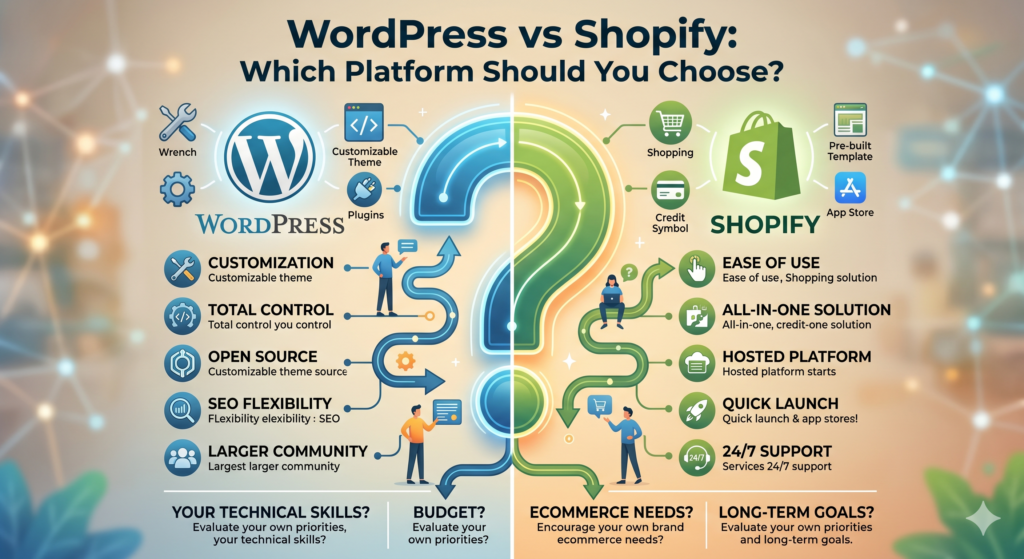
WordPress vs Shopify: Which Platform
Should You Choose?
WordPress and Shopify are two leading website platforms built for different business needs:
● WordPress is a flexible, open-source CMS ideal for content-heavy websites, custom
functionality, and scalable business growth.
● Shopify is an all-in-one ecommerce platform designed for fast and easy online
selling.
Choose Shopify for simplicity and quick ecommerce launches, and choose WordPress for
flexibility, SEO control, and long-term scalability.
Introduction
Choosing the wrong website platform can cost your business time, revenue, and growth
opportunities.
Many businesses start with a platform that works “for now” only to realize later that it limits
customization, SEO, integrations, or scalability.
That’s why the WordPress vs Shopify debate is one of the most important decisions for
businesses launching a new website or ecommerce store in 2026.
Both platforms are powerful, but they serve very different goals.
This guide breaks down the real differences between WordPress and Shopify from SEO
and customization to pricing and scalability so you can make the right long-term decision
for your business.
What Is WordPress?
WordPress is the world’s most widely used content management system (CMS), powering
over 40% of websites globally.
Originally created for blogging, WordPress has evolved into a highly flexible platform
capable of powering:
● Business websites
● Ecommerce stores
● Membership platforms
● LMS portals
● Enterprise websites
● Custom web applications
WordPress is open-source, meaning you fully own and control your website.
By integrating WooCommerce, WordPress becomes a powerful ecommerce platform
suitable for businesses of all sizes.
Best For
● SEO-focused businesses
● Content-heavy websites
● Custom functionality
● Scalable web platforms
● Businesses needing complete control
What Is Shopify?
Shopify is a hosted ecommerce platform specifically built for online selling.
Unlike WordPress, Shopify manages hosting, security, maintenance, and updates for you.
Its primary goal is simplicity: helping businesses launch and manage online stores quickly
without technical complexity.
Shopify includes:
● Product management
● Payment processing
● Shipping tools
● Inventory systems
● Ecommerce analytics
All within one ecosystem.
Best For
● Ecommerce startups
● DTC brands
● Dropshipping businesses
● Fast product launches
● Non-technical business owners
How WordPress and Shopify Work
How WordPress Works
With WordPress, you:
1. Purchase hosting
2. Install WordPress
3. Choose a theme
4. Add plugins for features
5. Customize as needed
You manage:
● Performance
● Security
● Updates
● Hosting environment
This gives maximum flexibility but also requires more technical management.
Businesses looking for WordPress development services for scalable websites often choose
WordPress because it removes platform limitations and allows complete customization.
How Shopify Works
Shopify is fully hosted.
You simply:
1. Create an account
2. Select a plan
3. Choose a theme
4. Add products
5. Launch your store
Shopify handles:
● Hosting
● Security
● Maintenance
● Server optimization
This makes it significantly easier for beginners.
Many fast-growing brands choose Shopify development services for high-converting stores
because Shopify simplifies ecommerce operations.
WordPress vs Shopify: Key Differences
| Feature | WordPress +
WooCommerce |
Shopify |
| Platform Type | Open-source CMS | Hosted SaaS |
| Primary Focus | Websites + Ecommerce | Ecommerce |
| Ease of Use | Moderate | Beginner-friendly |
| Customization | Unlimited | Limited by ecosystem |
| SEO Control | Full control | Good but limited |
| Hosting | Self-managed | Included |
| Maintenance | User-managed | Shopify-managed |
| Blogging | Excellent | Basic |
| Scalability | Very high | High |
| Monthly Costs | Flexible | Fixed monthly |
| Transaction Fees | Gateway fees only | Extra fees unless Shopify
Payments |
| App Ecosystem | 59,000+ plugins | 8,000+ apps |
Is WordPress Better Than Shopify?
WordPress is better for flexibility, SEO, and customization, while Shopify is better for ease of
use and fast ecommerce setup.
The right choice depends on:
● Your business goals
● Technical capabilities
● Growth plans
● Content strategy
Businesses planning aggressive SEO growth and custom functionality often prefer
WordPress.
Brands prioritizing speed-to-market and operational simplicity often choose Shopify.
WordPress Benefits
1. Complete Customization
WordPress allows full control over:
● Design
● Features
● User experience
● Backend functionality
There are virtually no limitations.
2. Superior SEO Flexibility
WordPress offers advanced SEO control through plugins like:
● Rank Math
● Yoast SEO
You can optimize:
● Schema markup
● Meta data
● Technical SEO
● Site architecture
This is why many businesses investing in ecommerce website development for growing
brands prefer WordPress for long-term organic growth.
3. Better Content Marketing
WordPress was built for publishing content.
Its blogging capabilities are significantly more advanced than Shopify.
This makes WordPress ideal for:
● SEO strategies
● Content hubs
● Authority building
● AI-search visibility
4. Lower Long-Term Costs
While setup may require development investment, WordPress often becomes more
cost-effective over time, especially for larger businesses.
WordPress Limitations
● Requires hosting management
● More technical setup
● Plugin conflicts can occur
● Security depends on maintenance
● Requires developer support for advanced features
Shopify Benefits
1. Fastest Ecommerce Launch
Shopify dramatically reduces setup complexity.
Many stores can launch within days.
2. Beginner-Friendly
No coding knowledge is required for basic store setup.
Shopify handles:
● Infrastructure
● Security
● Maintenance
3. Reliable Ecommerce Ecosystem
Shopify provides:
● Stable hosting
● Secure checkout
● Built-in ecommerce tools
This reduces operational overhead.
4. Excellent Multichannel Selling
Shopify integrates easily with:
● Instagram
● TikTok
● Amazon
● Facebook Shops
Shopify Limitations
● Monthly costs increase over time
● Limited customization flexibility
● Heavy app dependency
● Basic blogging features
● Platform lock-in concerns
● Additional transaction fees
Which Is Better for SEO?
WordPress vs Shopify SEO Comparison
Technical SEO
WordPress provides deeper technical SEO control.
You can customize:
● URL structures
● Schema markup
● Page optimization
● Caching
● Core Web Vitals
Shopify supports SEO well, but with less backend flexibility.
Blogging Capabilities
WordPress dominates content marketing.
For businesses relying on:
● Organic traffic
● Blogging
● Topic clusters
● Authority content
WordPress is the stronger option.
Page Speed
Both platforms can achieve excellent performance.
However:
● Shopify performance is managed automatically
● WordPress performance depends on hosting and optimization
Schema & Structured Data
WordPress gives significantly more schema flexibility.
This matters for:
● Rich snippets
● AI extraction
● Featured snippets
Businesses prioritizing SEO growth often benefit from custom web application development
solutions and advanced WordPress optimization strategies.
Is Shopify Easier to Use Than
WordPress?
Yes, Shopify is easier to use because it is fully hosted and requires minimal technical setup.
WordPress offers more flexibility and power, but it requires:
● Hosting setup
● Plugin management
● Security maintenance
For non-technical users, Shopify usually has a shorter learning curve.
Use Cases: When to Choose WordPress
Choose WordPress if:
● SEO is a major growth channel
● You need custom functionality
● You want full ownership and control
● Your business requires advanced scalability
● Content marketing is central to your strategy
● You’re building beyond a basic online store
Best Choice for Growing Businesses
If your long-term growth depends on SEO, flexibility, and custom integrations, WordPress is
often the smarter investment.
Use Cases: When to Choose Shopify
Choose Shopify if:
● You want to launch quickly
● Your focus is ecommerce only
● You prefer simplicity over flexibility
● You don’t want to manage hosting
● You need built-in ecommerce tools
● Your team is non-technical
Best Choice for Fast Ecommerce Launches
If speed and simplicity matter most, Shopify helps businesses go live quickly with minimal
operational complexity.
Cost Comparison: WordPress vs Shopify
WordPress Costs
Typical annual costs include:
● Hosting: $100–$600/year
● Premium themes: $50–$200
● Plugins/extensions: $200–$1000+
● Maintenance: Variable
Total cost depends heavily on customization.
Shopify Costs
Typical annual costs include:
● Basic Shopify: $348/year
● Shopify apps: $200–$2000+/year
● Transaction fees: Variable
● Premium themes: Optional
Shopify offers more predictable monthly pricing.
Quick Summary: WordPress vs Shopify
● Choose WordPress if you need flexibility, SEO control, and long-term scalability.
● Choose Shopify if you want a fast, easy-to-manage ecommerce platform.
● Choose custom ecommerce development if your business requires advanced
features, integrations, or enterprise-level scalability.
Which Platform Is Right for Your
Business?
The right platform depends on your growth strategy.
If your business prioritizes:
● Content marketing
● SEO authority
● Custom workflows
● Long-term scalability
WordPress is usually the stronger foundation.
If your goal is:
● Fast ecommerce launch
● Simple store management
● Minimal technical maintenance
Shopify may be the better fit.
Not sure which platform fits your business?
At WEAMSE, we help businesses choose, build, and scale the right digital platform based on
real business goals not trends or limitations.
Whether you need:
● WordPress development
● Shopify development
● Ecommerce website development
● Custom web application development
our team helps build scalable digital experiences designed for growth.
Frequently Asked Questions
Is WordPress better than Shopify for SEO?
Yes, WordPress generally offers better SEO flexibility because it provides full control over
technical optimization, schema markup, content structure, and plugin functionality. Shopify
has strong SEO capabilities, but WordPress allows deeper customization for advanced SEO
strategies.
Can WordPress handle ecommerce?
Yes, WordPress with WooCommerce powers millions of ecommerce stores worldwide. It
supports physical products, subscriptions, memberships, digital products, and custom
ecommerce workflows.
Is Shopify better for beginners?
Yes, Shopify is significantly easier for beginners because hosting, security, and maintenance
are managed automatically. WordPress requires more technical setup and ongoing
management.
Which platform is cheaper?
WordPress can be cheaper long-term, especially for large or content-heavy websites.
Shopify offers simpler pricing but monthly subscriptions and app costs can increase over
time.
Can I migrate from Shopify to WordPress?
Yes, businesses can migrate from Shopify to WordPress or vice versa. However, migrations
require careful handling of SEO, URLs, customer data, and product information to avoid
traffic loss.
Which platform scales better?
Both platforms scale effectively, but in different ways. Shopify handles infrastructure
automatically, while WordPress offers greater flexibility for businesses needing custom
scalability and advanced functionality.
Is Shopify or WordPress better for ecommerce?
Shopify is better for businesses wanting simple ecommerce operations, while WordPress is
better for businesses needing advanced customization, SEO, and content-driven growth.
Ready to Build the Right Platform for
Your Business?
Choosing the wrong platform can cost months of time, lost rankings, and thousands in
redevelopment costs.
The right foundation impacts:
● SEO growth
● Conversions
● Scalability
● Long-term profitability
At WEAMSE, we help businesses across the USA, UK, UAE, and Australia build
high-performance digital platforms that scale with growth.
Whether you need:
● A high-converting Shopify store
● A scalable WordPress website
● Advanced ecommerce functionality
● Custom development solutions
our team is ready to help.
Get a free consultation and build the right foundation for your business.